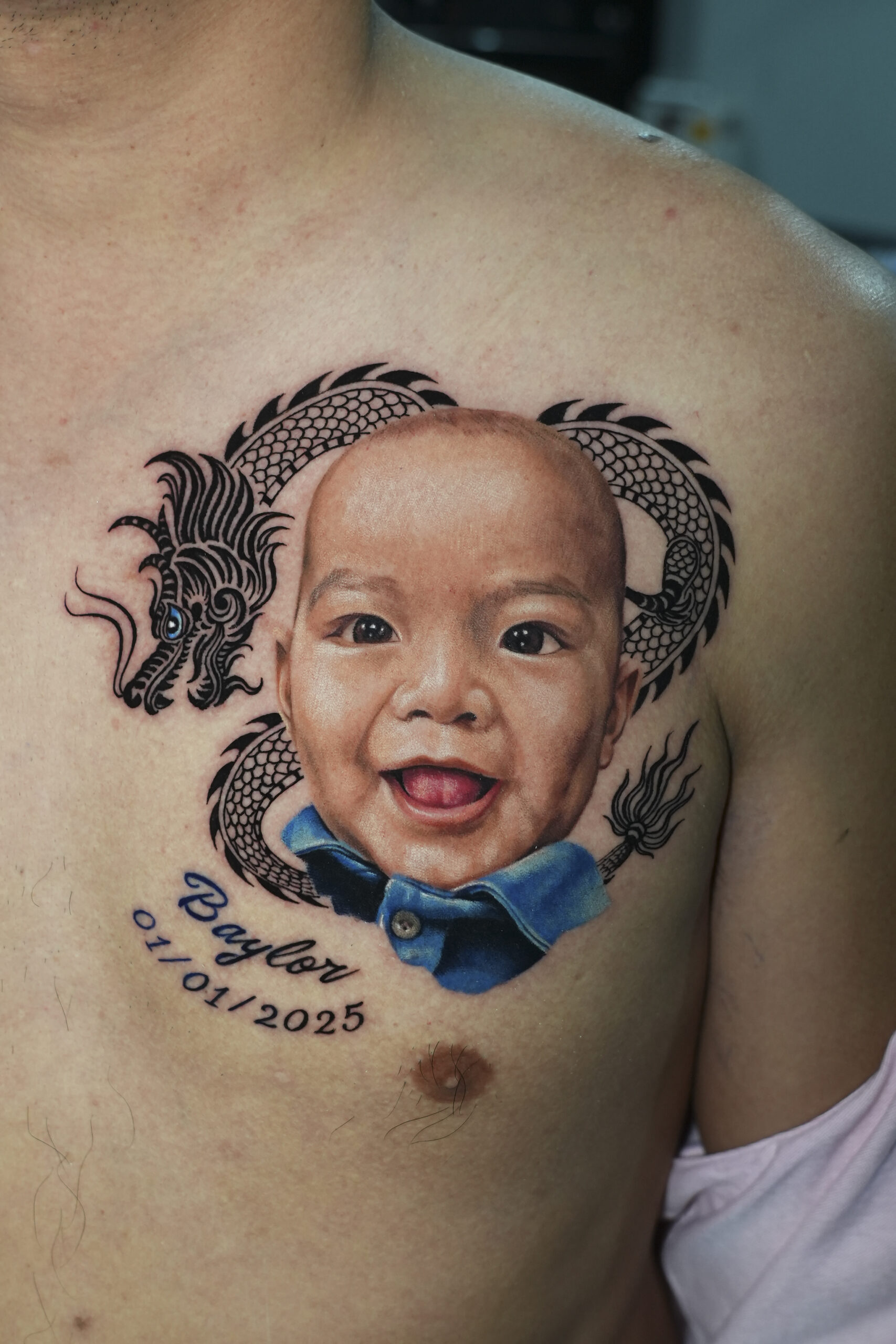
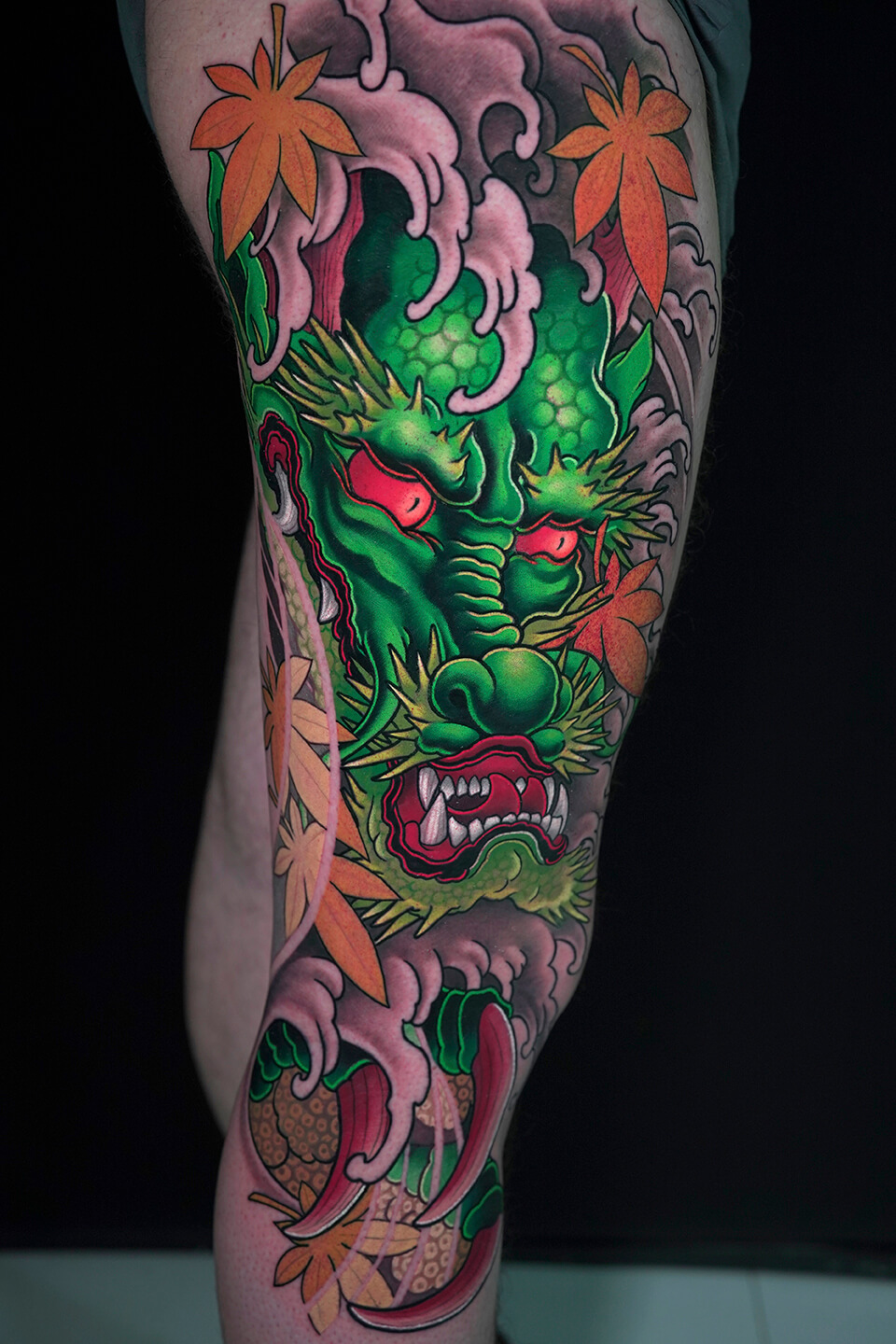
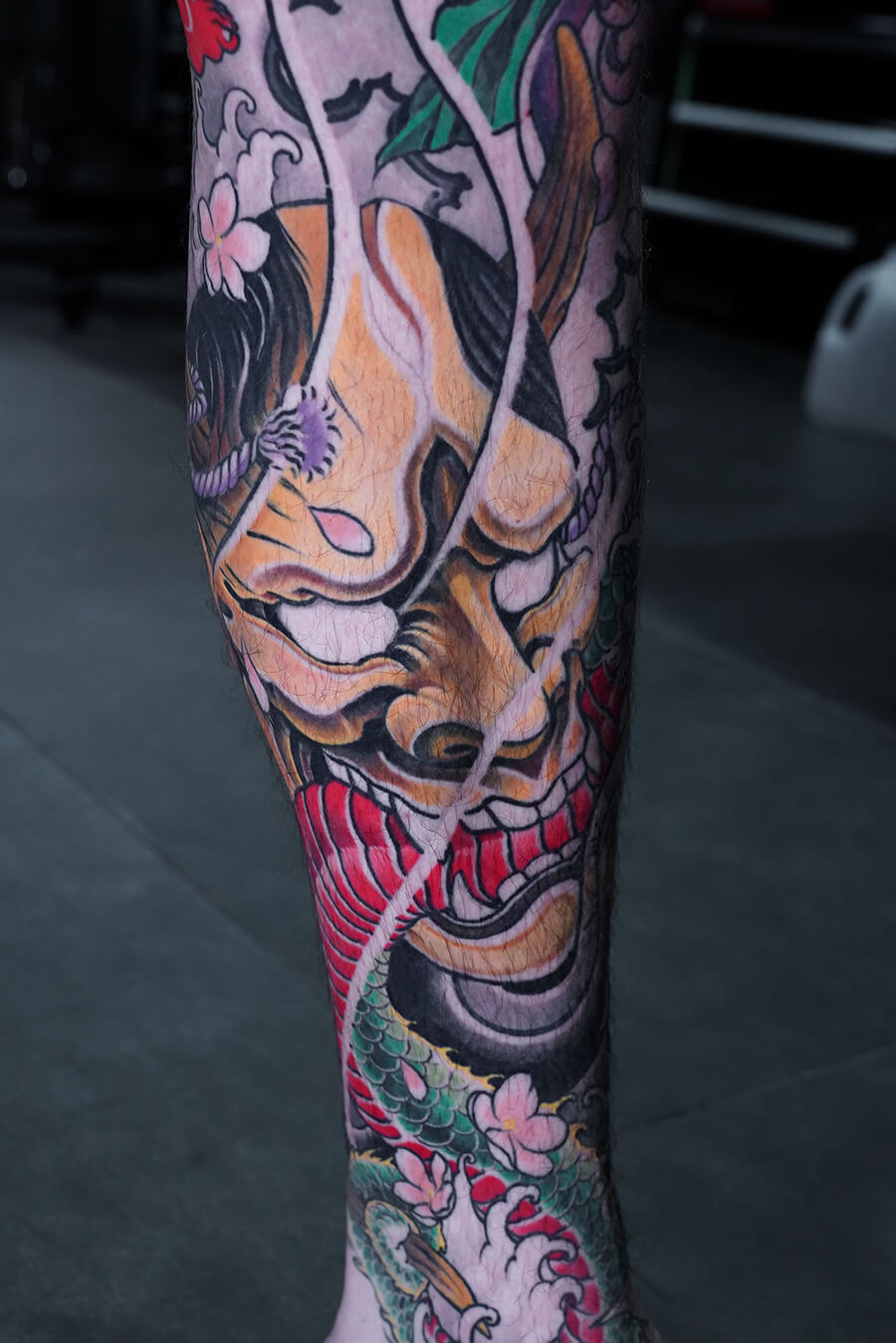
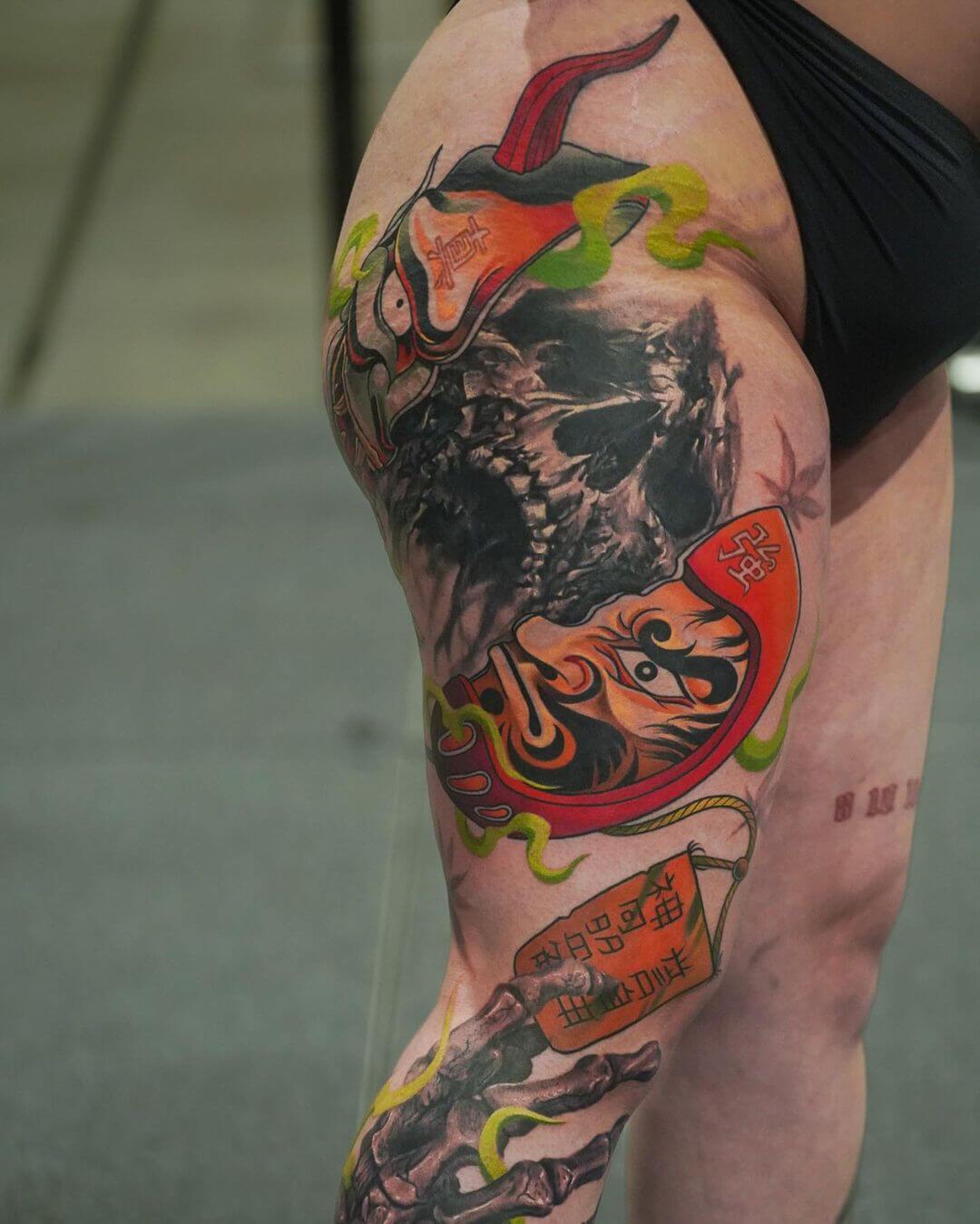
Report highlights. According to the most comprehensive global survey data from 2018-2024, Italy ranks as the most tattooed country in the world at 48% prevalence, followed closely by Sweden (47%) and the United States (46%). Europe and the Americas dominate global rankings, while Asia-Pacific represents the fastest-growing market at 11.6-12.6% annual growth. Approximately one in three adults in Western developed nations now has at least one tattoo, with women (38%) surpassing men (27%) in prevalence across most countries—a complete reversal of historical patterns.
- Italy has the highest tattoo prevalence globally at 48%.
- Sweden follows closely at 47%, tied with strong Viking heritage.
- The United States ranks third at 46% (internet users survey) and 32% (national survey).
- Australia and Argentina both have 43% prevalence.
- 38% of American women have tattoos versus 27% of men.
- The global tattoo industry reached $2.3 billion in 2024.
- Asia-Pacific is the fastest-growing market at 12.6% annually.
- India has the lowest prevalence at just 3%.
Related reports include: How many people have tattoos in The US | Tattoo regret statistics
1. Which Countries Have the Highest Tattoo Prevalence?
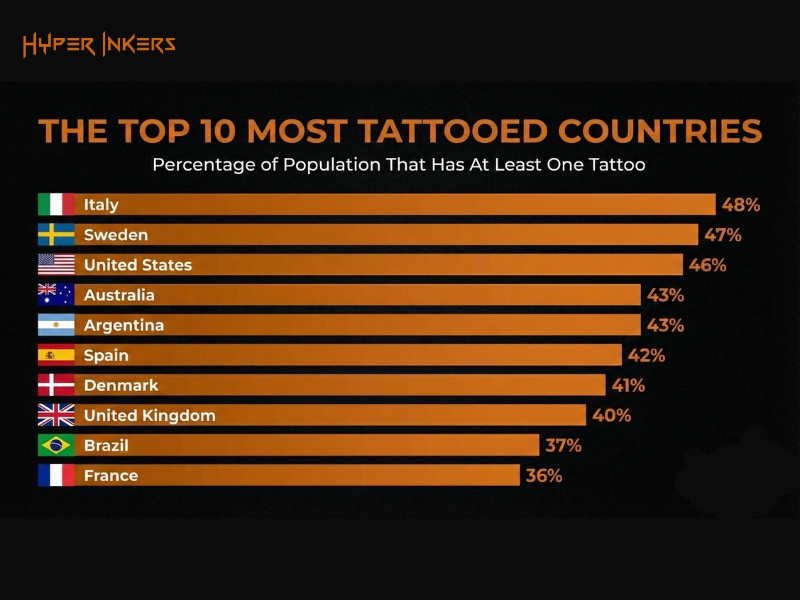
Based on the 2018 Dalia Research survey of 18 countries, Italy ranks as the global leader in tattoo adoption, with nearly half of its population possessing body art. The data confirms that Southern and Northern European nations currently dominate the top rankings, surpassing traditional markets in North America.
The following table outlines the top 10 nations where tattoos are most popular:
| Rank | Country | Prevalence | Region |
| 1 | Italy | 48% | Southern Europe |
| 2 | Sweden | 47% | Northern Europe |
| 3 | United States | 46% | North America |
| 4 | Australia | 43% | Oceania |
| 4 | Argentina | 43% | South America |
| 6 | Spain | 42% | Southern Europe |
| 7 | Denmark | 41% | Northern Europe |
| 8 | United Kingdom | 40% | Western Europe |
| 9 | Brazil | 37% | South America |
| 10 | France | 36% | Western Europe |
Notable findings:
- Germany: 36%
- South Africa: 33%
- Canada: 33%
- Turkey: 30%
- Israel: 25%
- India: 3% (lowest globally)
2. How Does Tattoo Prevalence Vary by Region?
Europe is currently the most tattooed continent globally, capturing 33% of the global tattoo market share. Regional analysis reveals distinct patterns of adoption driven by cultural heritage and modern social acceptance.
2.1 Europe Leads Globally
Southern and Northern Europe demonstrate the highest adoption rates, driven by a blend of fashion, heritage, and artistic expression.
- Southern Europe: Italy leads at 48%, followed by Spain at 42%.
- Northern Europe: Sweden reports 47%, with Denmark at 41%.
- Western Europe: The UK reports 40%, while France and Germany both stand at 36%.
- Market Share: Europe captures 30-33% of the global market.
- Cultural Context: The region maintains strong historical connections to Viking and Mediterranean tattoo traditions.
2.2 North America and Oceania Follow Closely
While Europe holds the top individual spots, North America and Oceania maintain consistently high prevalence rates across their populations.
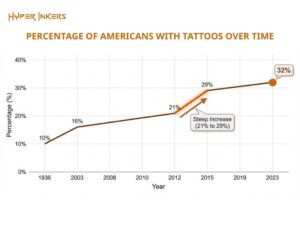
- United States: Recent Pew Research (2023) indicates 32% of Americans have tattoos.
- This represents an increase from 21% in 2012 and 29% in 2015.
- Prevalence rises to 46% among Millennials aged 30-49.
- Canada: Reports a 33% prevalence rate.
- Australia: McCrindle Research (2020) indicates a 25% prevalence rate.
- Notably, 31% of Australian women are tattooed.
2.3 Asia-Pacific Shows Rapid Growth
The Asia-Pacific region currently reports the lowest overall prevalence but stands as the fastest-growing market globally, expanding at a rate of 12.6% annually.
- Singapore: Leads Asian youth adoption with 25% of millennials having tattoos.
- South Korea: Approximately 25% prevalence, despite legal restrictions remaining in place until 2025.
- Japan: Maintains low prevalence due to lingering yakuza stigma.
- India: Reports the lowest rate globally at 3%.
2.4 Middle East and South Asia
This region reports the lowest global prevalence primarily due to religious and cultural restrictions. Sunni Islamic teaching generally considers tattoos haram (forbidden), significantly suppressing adoption rates.
Why Italy, Sweden, and the US Lead in Tattoo Adoption?
Specific cultural, historical, and media factors drive the high adoption rates in the world’s leading tattoo markets.
Italy (48% – Highest Globally) Despite strong Catholic traditions, Italians have embraced tattoos as a primary form of artistic self-expression and fashion.
- Religious imagery remains popular, coexisting with Catholic traditions.
- Strong heritage pride drives demand for body art.
- Southern Italy shows higher adoption rates than northern regions.
- Rome hosts the highest density of tattoo artists nationally.
Sweden (47% – Second Highest) Sweden’s high ranking is deeply rooted in its Viking heritage, which historically valued body art, combined with modern liberal attitudes.
- Deep Viking heritage acts to normalize body art in society.
- Modern Scandinavian attitudes favor personal expression.
- Nordic mythology and nature imagery remain highly popular motifs.
United States (32-46% depending on survey) The United States has driven the mainstreaming of tattoo culture through global media influence and celebrity adoption.
- Celebrity Influence: Figures like David Beckham, Rihanna, and Angelina Jolie have normalized ink.
- Media Impact: Reality shows like Miami Ink (2005) brought tattooing into mainstream living rooms.
- Social Media: Instagram (2010+) provided a massive visual platform for artists.
- Acceptance: 80% of Americans now acknowledge increased social acceptance of tattoos.
South Korea (25% – Changing Rapidly) South Korea represents a unique market where cultural popularity has outpaced legislation.
- Estimated 13 million Koreans have tattoos (1 in 4 people).
- Tattooing was illegal until the passing of The Tattooist Act (Sept 2025).
- K-pop Influence: Stars like G-Dragon and Jay Park drive youth adoption.
- Public Support: 80% of Koreans in their 20s supported legalization.
Japan (Low Prevalence – Strong Stigma) Japan retains a complex relationship with tattoos, balancing a rich artistic history with modern societal exclusion.
- An exquisite irezumi tradition exists but is often hidden.
- Historical Yakuza associations continue to suppress mainstream adoption.
- 70% of onsen (public baths) still ban tattooed guests.
- Only 60% of young Japanese support easing these restrictions.
What Is the Global Tattoo Industry Market Size?
The tattoo industry continues to demonstrate robust financial expansion across all major markets, driven by rising acceptance and technological advancements.
Overall Market Valuation:
- 2024 Market Value: Reached $2.2-2.3 billion globally.
- Future Projection: Expected to surpass $5+ billion by 2032.
- Growth Rate: Maintains a steady 9.5-10% CAGR (Compound Annual Growth Rate).
Market Share by Region:
| Region | Market Share | Growth Rate |
| North America | 40-42% | Steady |
| Europe | 30-33% | Moderate |
| Asia-Pacific | Growing | 12.6% (fastest) |
United States Tattoo Industry Analysis:
- Infrastructure: There are 23,774 tattoo parlors operating nationwide.
- Growth: The number of parlors increased by 60% between 2010-2020.
- Revenue: The US market generates $1.3 billion annually.
- Pricing: The average tattoo cost ranges from $50 to $3,000.
Consumer Satisfaction and Regret:
- Satisfaction: 92% of individuals are happy with their tattoos overall.
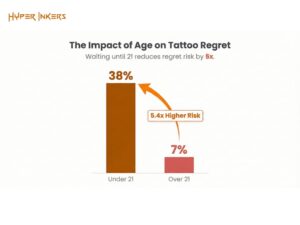
- Regret: 24% report regretting at least one tattoo.
- Top Reason for Regret: Tattoos featuring another person’s name.
- Removal Market: The tattoo removal sector has grown 32% since 2011.
Which Traditional Tattoo Cultures Are Experiencing a Revival?
Indigenous tattoo traditions across Polynesia, Southeast Asia, and the Philippines are witnessing a remarkable cultural renaissance, reclaiming ancient practices that were once suppressed.
Polynesian and Pacific Traditions:
- Māori Tā Moko (New Zealand):
- These facial and body tattoos represent genealogy and social status.
- Nanaia Mahuta became the first world leader to wear a facial moko in 2020.
- The cultural renaissance began in the 1980s following a period of colonial decline.
- Thai Sak Yant:
- A 1,000-2,000 year old spiritual tradition.
- Consists of sacred geometric patterns inked by monks.
- The Wat Bang Phra temple receives thousands of devotees annually.
- Filipino Batok:
- An ancient art form preserved primarily in the Cordilleran highlands.
- Whang-od Oggay (106 years old) brought global attention by appearing on Vogue Philippines (2023).
- Tourism to the region increased from 30,000 (2010) to 170,000 (2016) due to interest in Batok.
Viking Heritage Connections:
- Historical accounts by Arab diplomat Ibn Fadlan (921 AD) described Rus Vikings as being tattooed “from fingertips to neck.”
- Modern Scandinavian prevalence rates connect directly to this heritage.
- Sweden (47%) and Denmark (41%) lead Northern Europe, reflecting this cultural resurgence.
Key takeaways
For researchers and journalists
- Italy and Sweden have highest prevalence at 48% and 47%
- Europe is the world’s most tattooed continent
- Women now outpace men in Western countries
- Millennials are the most tattooed generation in history
For industry professionals
- Global market reaching $2.3B in 2024, projected $5B+ by 2032
- Asia-Pacific offers fastest growth at 12.6% annually
- Mobile optimization critical as younger demographics dominate
- Traditional cultural tattoos experiencing revival worldwide
For policy makers
- Social acceptance increased dramatically (80% acknowledge this)
- Legal restrictions falling (South Korea legalized 2025)
- Health and safety regulations increasingly important
- Cultural sensitivity needed around indigenous traditions
Sources
- Share of people with tattoos in selected countries 2018 – Statista
- 32% of Americans have a tattoo – Pew Research Center
- Which Country’s Residents Have the Most Tattoos? – WorldAtlas
- Tattoo Statistics Australia 2022 – Disappear Laser
- New Australian Tattoo Stats 2020 – Goodbye Tattoos
- Tattoo Market Size, Growth, Forecast 2032 – Fortune Business Insights
- Asia Pacific Tattoo Industry Report 2024 – Cognitive Market Research
- Tattoo Parlor Market Trends & Demographics Oct 2025 – BusinessDojo
- Tattooed Countries Statistics 2024 – World Metrics
- History of tattooing – Wikipedia
- Traditional Maori Tattoo of New Zealand – Brewminate
- Sacred Thai tattoos: Culture, Power, and Protection – Nation Thailand
- Whang-od – Wikipedia
- Viking Tattoos: Historical or Not? – History on the Net
- Tattooing in South Korea – Wikipedia
- Japanese Onsen and Ink—The Tattoo Taboo – Japan Travel
- More Americans Have Tattoos Today – Ipsos
- How Tattoos Went From Subculture to Pop Culture – HuffPost